- Jun 24
2026 update: What is the most effective exercise to build bone density?
- Frances Brown
- 0 comments
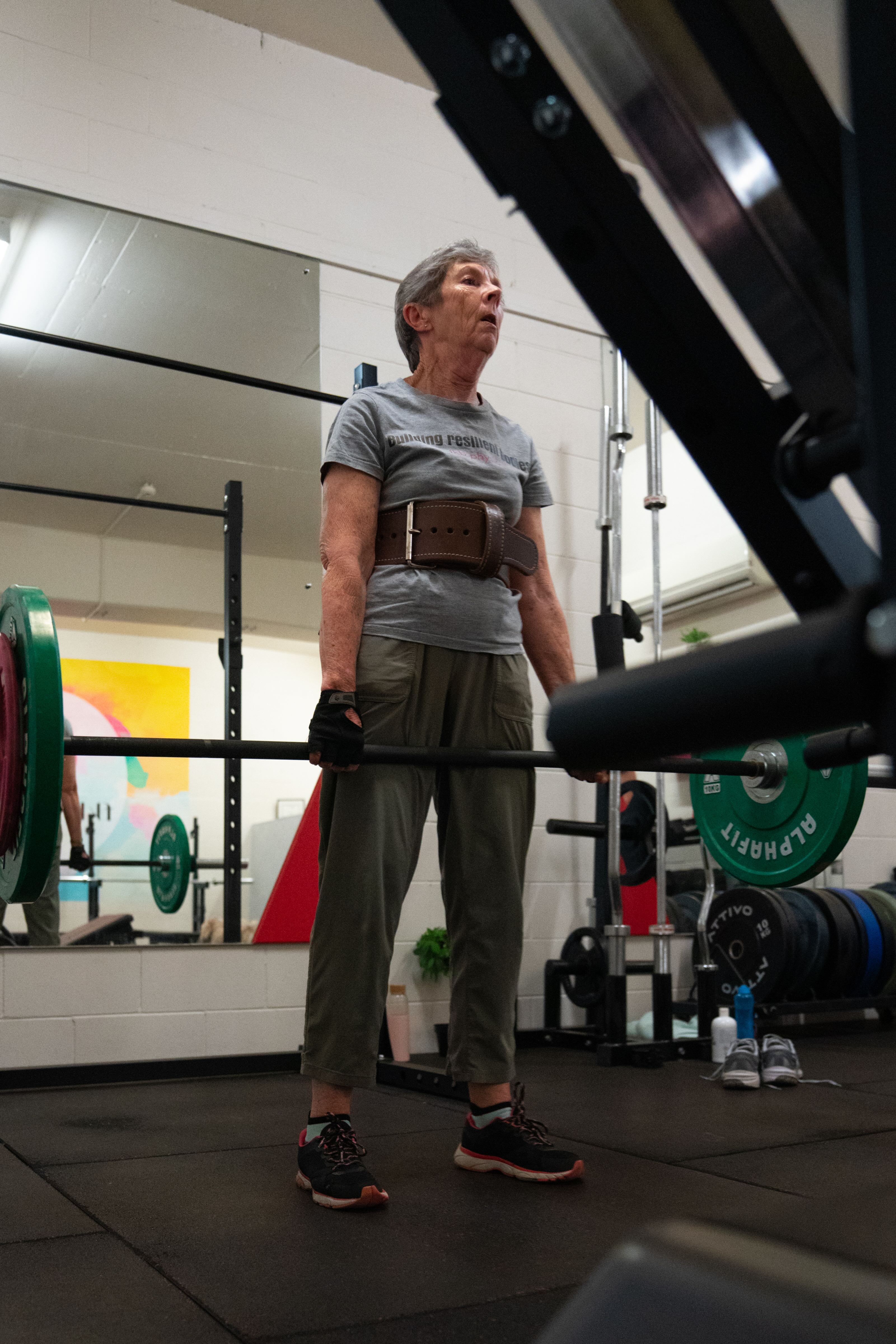
My mum lifting for her bones!
Note: nothing in this blog is intended to be taken as medical advice or in place of medical advice from a health professional. It is recommended to seek personal advice for your specific needs.
There is so much information out there right now about the type of exercise you need to do to build your bone density. A lot of it is conflicting, and confusing to understand.
I have put together the most important points below, based on a number of systematic reviews from the last 5 years, as well as the official guidelines for Australia, England and Canada.
While there are some differing concepts in the specifics, there are also some consistencies, and these are what I've collated below.
Summary:
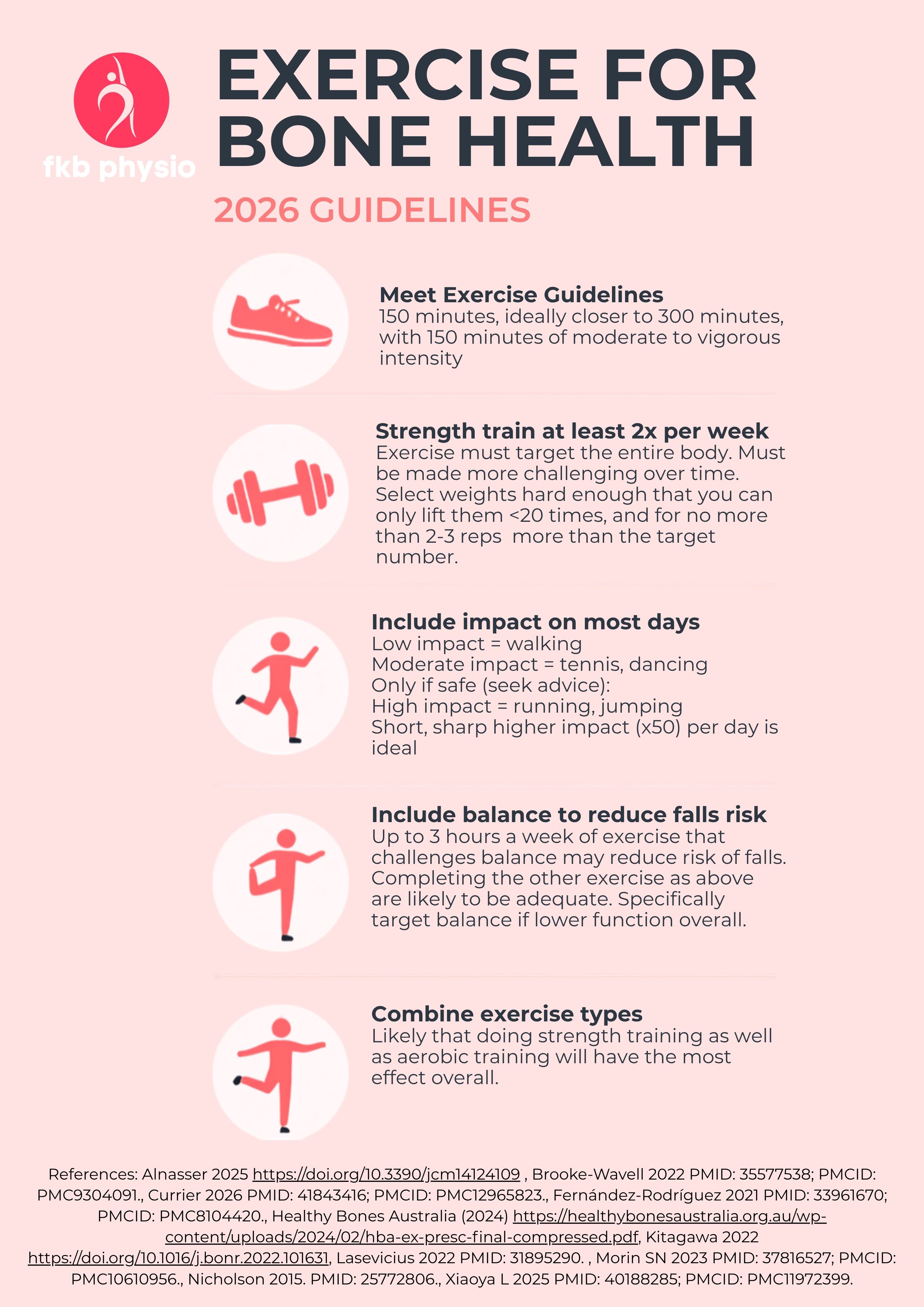
Meeting recommended exercise guidelines doing exercise of any sort is likely to be helpful. This is because people who exercise tend to have higher bone density than those that don't. The guidelines are a minimum of 150 minutes per week, but ideally 300 minutes or more.
To improve bone density, strengthening exercises that target all the muscle groups in the body should be completed a minimum of twice per week. This exercise needs to feature progressive overload - that is, the exercise must be made harder once it starts to feel easy.
A combination of modes of exercise is likely to be more beneficial than just one type (i.e. it is important to do strength training as well as cardiovascular training)
For those where it is safe to do so, impact loading should be included on most days of the week.
Balance training should be incorporated to reduce falls risk.
Detailed break down:
Meet exercise guidelines
There are types of exercise that are better for bone than others. For example, exercises that are non-weight bearing like swimming have close to no bone-building effect.
However, research suggests that people who meet exercise guidelines (a minimum of 150 minutes a week, but ideally 300 or more minutes, where 150 of those are moderate to vigorous intensity) tend to have better bone density than those who don't.
If you enjoy a type of exercise that isn't inherently bone-building, it is recommended you continue to do it, and rather look to add other forms of bone-build exercise to your routine, rather than stop.
Exercise has so made widespread benefits, it is important to continue to do forms of it that you enjoy.
Perform full body strengthening twice per week
Perhaps the most important type of exercise to include for bone density is strength training. Strength training means exercises that require you to move against an external force. Specifically, the training needs to target the whole skeleton, that is, target every muscle group, and it needs to be made progressively harder over time.
Essentially any exercise you do against an external force counts - that is, using weights, or bands, or against resistance springs (like at pilates). Even using your own body weight, like a squat or push up or pull up, counts.
Importantly, however, this exercise does need to be done to a level that is quite hard - the resistance needs to be such that you get to a point of almost not being able to do any more repetitions. As you get stronger, this needs to be made harder over time, i.e. the weight needs to get heavier. This is because bones adapt to stimulus that is new, not stimulus that is habitual.
The most effective way to do this type of exercise is specific resistance training, that is, lifting weights. While exercises like yoga and pilates are technically resistance training, they do not provide adequate progression of strength over time to constitute effective bone building exercise for most people.
Research tends to suggest that as long as you go towards failure (i.e. you lift a weight continually until you are unable to keep lifting it), the benefits are there for muscle and bone, though it is likely that weights you can lift a maximum of 20 times or less are probably more effective.
That is: if you are lifting say a 3kg weight, and you can lift it 20 times, but not 25 times, it is heavy enough. After a few weeks, you might feel like you could lift it 25 times; then you need to increase to 4kgs. In practice, it is often not practical time-wise to select weights that are so light you need to lift them this many times to approach fatigue. It may be better to choose weights you could lift a maximum of 10-12 times (but not 15 times), and continue to increase the weight once that becomes manageable.
This takes time and practice. When you are new to exercise, it is completely fine to work at a much lower intensity (easier) level than this, just to get used to the movements and learn how to do them. Over time, you can progress them towards harder efforts as described above.
A combination of modalities are likely to be more effective than just one.
Most of the advice in the bone density space is around strength training, and that is because it has the most solid evidence for directly building bone.
However, some of the studies that look more globally at bone density patterns and trends within different populations suggest that people who do both strength training and aerobic training tend to have better bone density.
This ties in well with point 1: include exercises you enjoy, alongside exercises that are more bone building.
Include impact loading on most days of the week
This is one to interpret with caution, because high impact loading (jumping) is not safe for some people. At its most basic level, this recommendation essentially means that ideally, including some type of impact exercise (including walking, as a low impact (but still impact) option) every day is beneficial. Exercises that are more moderate impact are things such as tennis or dancing, and high impact are things such as running or jumping.
Confusingly, running itself is not inherently bone building - the highly repetitive nature of it seems to tune out some of the bone building effects. But again, the suggestion is that people who do some form of impact exercise on most days are more protected than those who dont.
What might be specifically helpful is doing short, sharp bursts of higher impact loading, like jumping or hopping, a maximum of 50 times per day. This is something that must be considered very carefully and cautiously - for people who have low bone density, or haven't done a lot of exercise in years, this is likely to be far too extreme. If you are uncertain at all, it is best to consult a health professional about this recommendation.
Balance training
Of course one of the biggest risks of having low bone density is fracturing a bone following a fall. Preventing falls, therefore, is a major consideration in fracture risk reduction programs.
For a lot of people, who are not at imminent risk of falling (but want to keep it that way), simply including exercises that feature a balance component while focusing on a different modality (i.e. including lunges in a strength training program, including balance exercises in a yoga program) is sufficient, rather than targeted balance training.
For people who are more frail, specific balance training may be indicated. The Australian guidelines suggest 3 hours a week of exercise that challenges balance can reduce falls risk. This does not need to be additional to the strength and aerobic training discussed in earlier points.
References:
Alnasser, S. M., Babakair, R. A., Al Mukhlid, A. F., Al hassan, S. S. S., Nuhmani, S., & Muaidi, Q. (2025). Effectiveness of Exercise Loading on Bone Mineral Density and Quality of Life Among People Diagnosed with Osteoporosis, Osteopenia, and at Risk of Osteoporosis—A Systematic Review and Meta-Analysis. Journal of Clinical Medicine, 14(12), 4109. https://doi.org/10.3390/jcm14124109
Brooke-Wavell K, Skelton DA, Barker KL, Clark EM, De Biase S, Arnold S, Paskins Z, Robinson KR, Lewis RM, Tobias JH, Ward KA, Whitney J, Leyland S. Strong, steady and straight: UK consensus statement on physical activity and exercise for osteoporosis. Br J Sports Med. 2022 May 16;56(15):837–46. doi: 10.1136/bjsports-2021-104634. Epub ahead of print. PMID: 35577538; PMCID: PMC9304091.
Currier BS, D'Souza AC, Singh MAF, Lowisz CV, Rawson ES, Schoenfeld BJ, Smith-Ryan AE, Steen JP, Thomas GA, Triplett NT, Washington TA, Werner TJ, Phillips SM. American College of Sports Medicine Position Stand. Resistance Training Prescription for Muscle Function, Hypertrophy, and Physical Performance in Healthy Adults: An Overview of Reviews. Med Sci Sports Exerc. 2026 Apr 1;58(4):851-872. doi: 10.1249/MSS.0000000000003897. Epub 2026 Mar 5. PMID: 41843416; PMCID: PMC12965823.
Fernández-Rodríguez R, Alvarez-Bueno C, Reina-Gutiérrez S, Torres-Costoso A, Nuñez de Arenas-Arroyo S, Martínez-Vizcaíno V. Effectiveness of Pilates and Yoga to improve bone density in adult women: A systematic review and meta-analysis. PLoS One. 2021 May 7;16(5):e0251391. doi: 10.1371/journal.pone.0251391. PMID: 33961670; PMCID: PMC8104420.
Healthy Bones Australia (2024), Exercise Prescription to Support the Management of Osteoporosis For Physiotherapists and Exercise Physiologists February 2024, https://healthybonesaustralia.org.au/wp-content/uploads/2024/02/hba-ex-presc-final-compressed.pdf
Kitagawa T, Hiraya K, Denda T, Yamamoto S (2022), A comparison of different exercise intensities for improving bone mineral density in postmenopausal women with osteoporosis: A systematic review and meta-analysis, Bone Reports, Volume 17, 2022, 101631, ISSN 2352-1872, https://doi.org/10.1016/j.bonr.2022.101631. (https://www.sciencedirect.com/science/article/pii/S235218722200465X
Lasevicius T, Schoenfeld BJ, Silva-Batista C, Barros TS, Aihara AY, Brendon H, Longo AR, Tricoli V, Peres BA, Teixeira EL. Muscle Failure Promotes Greater Muscle Hypertrophy in Low-Load but Not in High-Load Resistance Training. J Strength Cond Res. 2022 Feb 1;36(2):346-351. doi: 10.1519/JSC.0000000000003454. PMID: 31895290.
Morin SN, Feldman S, Funnell L, Giangregorio L, Kim S, McDonald-Blumer H, Santesso N, Ridout R, Ward W, Ashe MC, Bardai Z, Bartley J, Binkley N, Burrell S, Butt D, Cadarette SM, Cheung AM, Chilibeck P, Dunn S, Falk J, Frame H, Gittings W, Hayes K, Holmes C, Ioannidis G, Jaglal SB, Josse R, Khan AA, McIntyre V, Nash L, Negm A, Papaioannou A, Ponzano M, Rodrigues IB, Thabane L, Thomas CA, Tile L, Wark JD; Osteoporosis Canada 2023 Guideline Update Group. Clinical practice guideline for management of osteoporosis and fracture prevention in Canada: 2023 update. CMAJ. 2023 Oct 10;195(39):E1333-E1348. doi: 10.1503/cmaj.221647. PMID: 37816527; PMCID: PMC10610956.
Nicholson VP, McKean MR, Slater GJ, Kerr A, Burkett BJ. Low-Load Very High-Repetition Resistance Training Attenuates Bone Loss at the Lumbar Spine in Active Post-menopausal Women. Calcif Tissue Int. 2015 Jun;96(6):490-9. doi: 10.1007/s00223-015-9976-6. Epub 2015 Mar 14. PMID: 25772806.
Xiaoya L, Junpeng Z, Li X, Haoyang Z, Xueying F, Yu W. Effect of different types of exercise on bone mineral density in postmenopausal women: a systematic review and network meta-analysis. Sci Rep. 2025 Apr 5;15(1):11740. doi: 10.1038/s41598-025-94510-3. PMID: 40188285; PMCID: PMC11972399.